Operating system and packaging
The PiRogue runs PiRogue OS, which is based on Debian 13 (Trixie) since PiRogue 3.0. PiRogue 2.x is based on Debian 12 (Bookworm). Debian is a renowned Linux distribution recognized for its stability, reliability, and commitment to open-source principles. It serves as a foundational platform for numerous other distributions and is widely adopted in various industries, including enterprise environments, scientific research, and embedded systems. Debian's trustworthiness stems from its long-standing reputation for quality, its rigorous testing and development processes, and its commitment to open and transparent collaboration.
Debian's stability is attributed to its conservative approach to software updates, ensuring that only thoroughly tested and stable packages are included in its repositories. This emphasis on stability makes Debian a preferred choice for mission-critical systems where reliability is paramount.
Debian's commitment to open-source principles fosters a collaborative development model that leverages the expertise of a vast community of developers and users. This open approach promotes transparency, encourages peer review, and ensures that Debian remains a community-driven project with a focus on quality and security.
On top of Debian, the PiRogue installs a set of established open-source tools for network traffic analysis, device forensics and threat intelligence gathering, listed in Pre-installed tools.
Integration with Raspberry Pi
PiRogue OS is a tailored version of Debian mainline, built for the Raspberry Pi. It runs on a bare Raspberry Pi: no add-on board is needed, and the supported models are listed in Hardware.
The generation of the operating system image to be flashed on an SD-card is ensured by Packer. It takes the official Debian image and applies changes such as creating a default user and configuring a PPA. The modifications applied to the official Debian image is available on GitHub https://github.com/PiRogueToolSuite/pirogue-images.
PiRogue features can be installed on a Raspberry Pi as well as on a regular computer equipped with a Wi-Fi interface and an Ethernet interface.
Packaging for PiRogue
All features and software installed on the PiRogue are packaged for Debian. The packages of PiRogue 3.x, for Debian 13, are published on the Debian 13 PPA. The packages of PiRogue 2.x, for Debian 12, stay available on the Debian 12 PPA.
A Personal Package Archive (PPA) serves as a repository for software packages maintained by individuals or teams outside of the official Debian distribution. It allows developers to distribute and update their software independently, providing users with access to newer versions or packages not yet included in Debian's main repositories. PPAs offer a convenient way to access other software but require cautious use as they may not undergo the same rigorous testing as official Debian packages.
PTS’s PPAs contain both PiRogue-specific tools as well as external tools that are not available on official Debian repository.
The packages are listed in Packages.
All PiRogue-specific packages are defined in the GitHub repository https://github.com/PiRogueToolSuite/deb-packages for Debian 13, on the branch debian-13.
PiRogue Debian packages can be installed on any compatible hardware running Debian 13 (without graphical environment).
PiRogue packages dependency tree
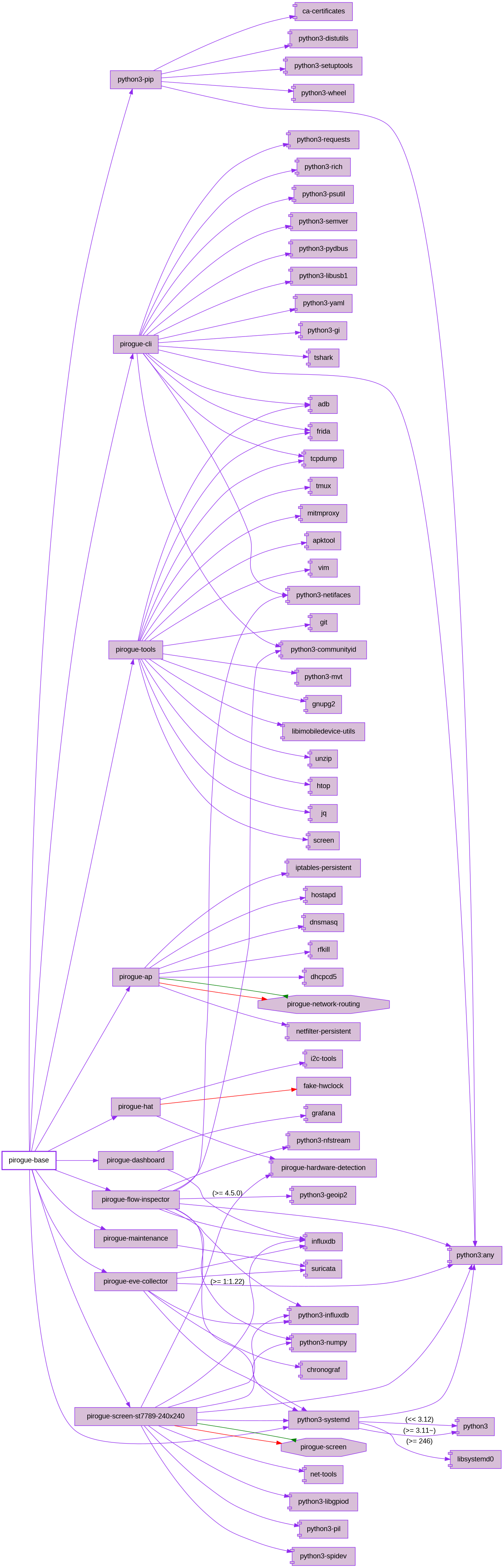
Because everything is a Debian package, upgrading Debian upgrades the PiRogue, see Upgrade a PiRogue.